


 Home
HomeTo test audio devices across both Bluetooth Classic and Bluetooth 5 standards, measurement equipment must ideally have reliable connectivity to these interfaces and the ability to provide stimulus across the range of profiles and codecs that Bluetooth audio devices use. Audio Precision's Bluetooth 5 module provides an interface to audio devices using the latest version of the Bluetooth specification, including LE Audio devices utilizing Unicast and Auracast, useful for designers and manufacturers of earbuds, headphones, headsets, hearing aids, speakers, automotive infotainment systems, etc. Our Bluetooth Duo delivers a wider selection of A2DP codecs, faster pair and connection times, an increased feature set within APx500 measurement software, and improved RF shielding for use in production test environments.
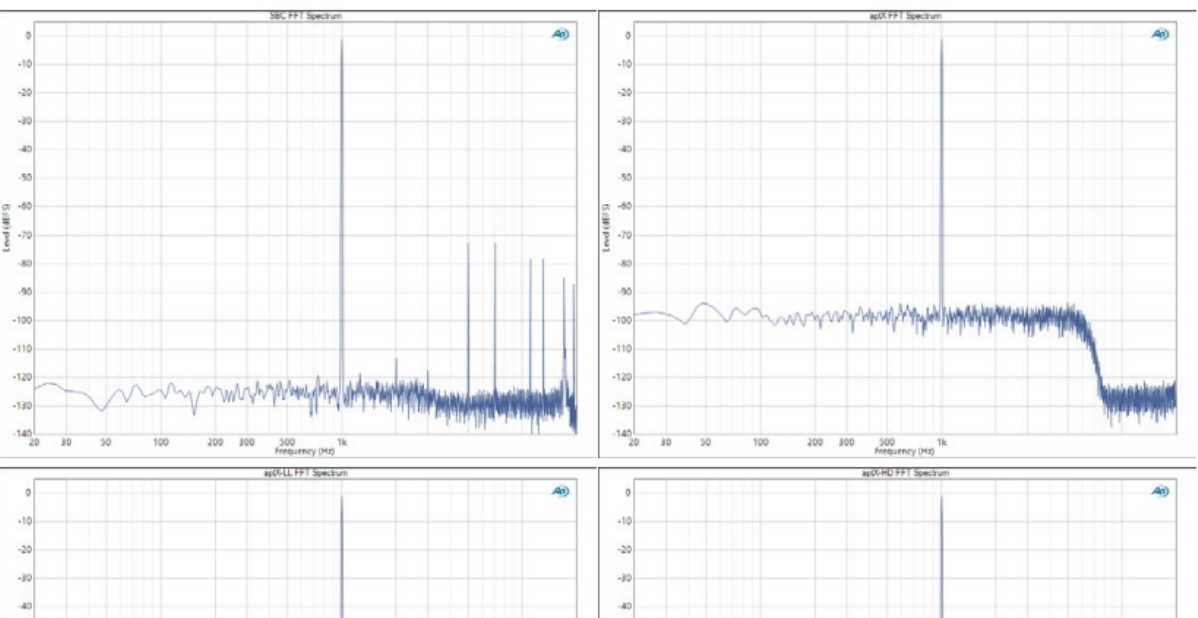
Technote 123: Measuring Bluetooth A2DP Profile Audio Quality
The A2DP Bluetooth® profile is used for high quality music transmission, employing a variety of supported codecs that include MPEG-1, MPEG-2, MPEG-4, AAC, ATRAC, aptX and aptX Low Latency. This technote illustrates how the APx Bluetooth option is used to control and monitor codec selection, measure latency, and test all essential audio parameters such as frequency response and THD+N for Bluetooth-enabled music playback devices.
Additional Resources
Visit Our Technical Library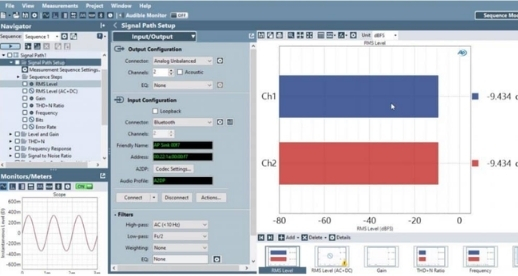
A Step by Step Guide to setting up the APx Bluetooth Duo Module
For users getting familiar with the APx Bluetooth Duo module, get a step-by-step guide to configure APx500 software (v4.5 software or later) and pair it with your device-under-test (DUT).
Read Now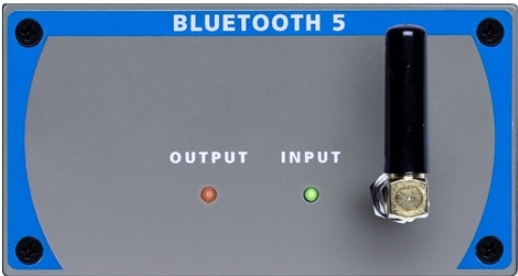
APx Bluetooth 5 Option Datasheet
Audio Precision’s third-generation Bluetooth® module, the APx Bluetooth 5, delivers Bluetooth LE Audio capabilities. APx Bluetooth 5 supports Bluetooth specification v5.4, with Unicast Voice (transmit and receive), Unicast Music (transmit), and Auracast (broadcast transmit).
Download Now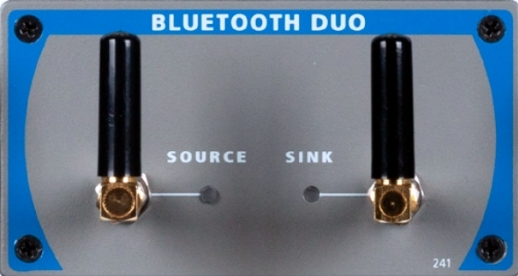
APx Bluetooth Duo Option Datasheet
The APx Bluetooth Duo delivers a wider selection of A2DP codecs, faster pair and connection times, increased features within the APx500 software, and improved RF shielding for use in production test environments. It supports Bluetooth core specification v4.2, HFP v1.7, HSP v1.2, AVRCP v1.4 and A2DP v1.3.
Download Now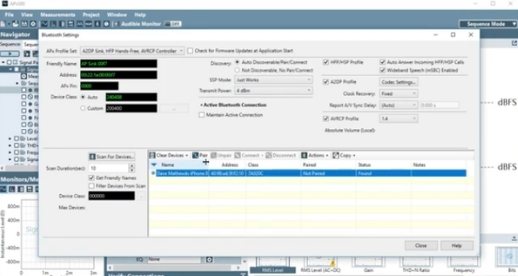
Quick Tip 141 – Bluetooth Duo Module
This brief video provides a brief overview of the Bluetooth® Duo I/O module, including its integration with APx500 measurement software. The module is an available option for both B Series and Legacy APx555, APx52x and APx58x audio analyzers.
Watch Now
More about Bluetooth SSP Mode
APx provides four SSP (Secure Simple Pairing) options, and this article explores how to choose the option that is appropriate for the Bluetooth device you are testing.
Read NowBluetooth Audio Testing Solutions
Browse All Products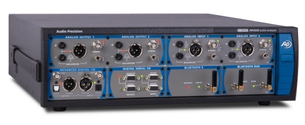
APx555B
The standard in performance and versatility in audio analysis. High-performance, modular two-channel audio analyzer.
APx58xB
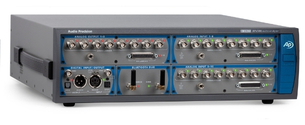
Channel count meets broad range of digital I/O for simultaneous, multichannel audio test. 8 or 16-channel modular audio analyzers.
Learn More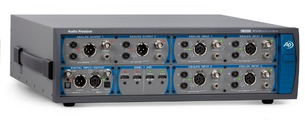
APx52xB
The ideal balance of analog performance and breadth of digital I/O. Modular, 2- and 4-channel performance audio analyzers.
Learn More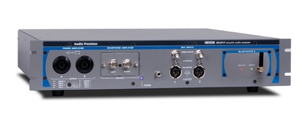
APx517B
Designed for electro-acoustic testing, featuring dedicated power amplifiers to drive loudspeakers and headphones.
Learn More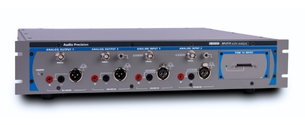
APx516B
Value oriented, with flexible digital audio connectivity for testing consumer electronic devices and other applications.
Learn More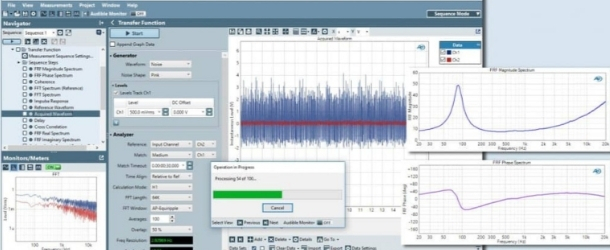
APx500 Software
APx500 is a powerful and versatile audio measurement software platform designed by AP, serving as a common software platform for all APx audio analyzers.
Learn MoreAn Introduction to the Bluetooth 5 LE Audio Interface for APx
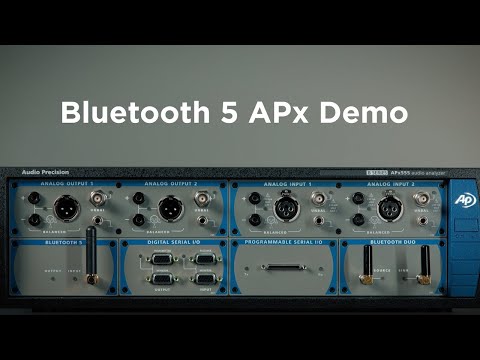
In this video, Audio Precision General Manager Daniel Knighten introduces the Bluetooth 5 LE interface module for APx analyzers, demonstrating how to measure audio performance for Bluetooth 5 LE–compatible devices.
Frequently Asked Questions About Bluetooth Audio Testing
As a technology, Bluetooth is effectively a part of everyday life, a fact that reflects its great utility. That flexibility is reflected in the various Bluetooth profiles used in a wide range of consumer devices from headphones and headsets to loudspeakers (smart or otherwise) and even vehicle infotainment systems. There are four main profiles in Bluetooth Classic which pertain to audio measurement:
- Hands Free Profile (HFP) – device as source (Audio Gateway) or sink (Hands Free). Bi-directional audio using CVSD and mSBC (wideband speech) audio codecs.
- Headset Profile (HSP) – device as source (Audio Gateway) or sink (Headset). Bi-directional audio using CVSD and mSBC (wideband speech) audio codecs.
- Advanced Audio Distribution Profile (A2DP) – device as source or sink. High-quality stereo audio using one of a selection of audio codecs.
- Audio Video Remote Control Profile (AVRCP) – device as source (Target) or sink (Controller). AVRCP supports A2DP with transport controls, delay compensation and absolute volume settings.
Bluetooth 5 measurement presents new complexities by bringing to market the following technologies:
- Unicast Music & Voice – these provide point to point audio streaming replacing the functionality previously provided by A2DP (Advanced Audio Distribution Profile) and HFP (Hands-Free Profile) in Classic, v4 and earlier, Bluetooth implementations.
- LC3 – a new audio codec promoted as providing higher quality audio while requiring less power.
- Auracast – a completely new feature which allows an audio stream to be broadcast to many receivers. This feature is being promoted by h
An audio device being evaluated may need to be tested for multiple profiles and, potentially, as both source and sink for each profile. This means any measurement system must support the same profiles as both source and sink, along with the various codecs in use by the device.
The function of a codec is to encode audio at the source and decode it at the sink. This means reducing the data rate in the process but doing it as transparently as possible, since the performance of different codecs can affect perceived audio quality. No codec is linear and therefore will always degrade measured performance as compared to a linear device. As such, unexpected harmonics, noise, or other unusual artifacts may be seen when analyzing measurement signals through codecs.
Regardless of profile selected, a Bluetooth device is constantly transmitting and receiving radio signals. When sending audio, the device functions as an audio source; when receiving audio, the device functions as an audio sink. When testing a Bluetooth speaker, for example, an audio test system’s output would be configured as a Bluetooth source, and its input would be configured as analog, connected to a microphone that picks up the speaker’s acoustic output. When testing a microphone (as found in a Bluetooth headset), the audio test system’s output would be configured as analog to drive a loudspeaker to acoustically stimulate the microphone, and the instrument’s input would be configured as a Bluetooth sink.